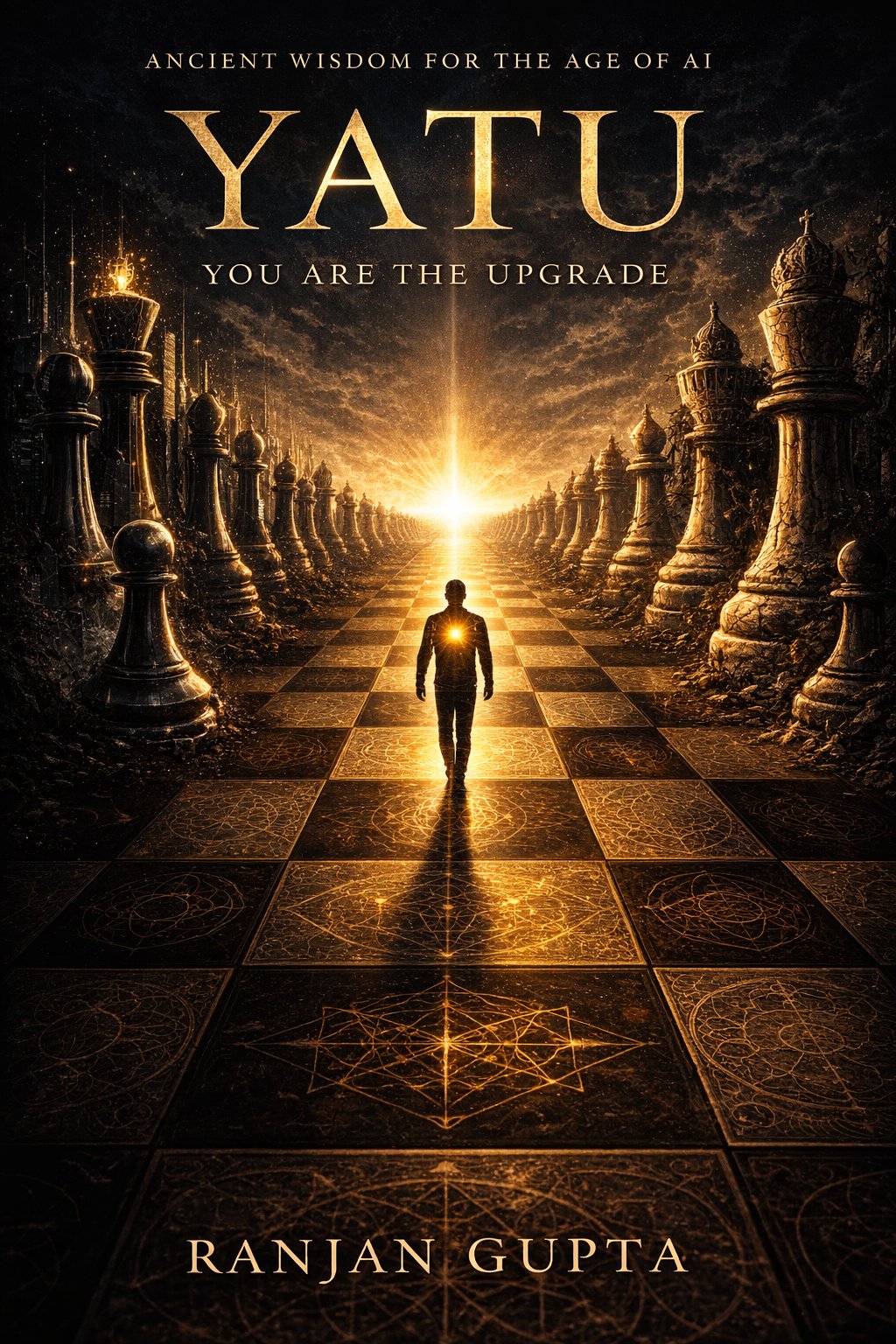
Ancient Consciousness Science for the AI Age
YATU
A book by Ranjan Gupta
Ancient Consciousness Science for the AI Age
A book by Ranjan Gupta
Everyone is asking what AI will do to us.
This book asks what was already inside us
— long before we built the machines.
The real upgrade isn't artificial.
It never was.
YATU is a 60,000-word journey through 24,000 years of human civilization — mapped not by politics or economics, but by the cosmic energy cycles that ancient India's greatest scientists encoded in the Vedas. It bridges the Bhagavad Gita's battlefield with today's AI anxiety, revealing that the inner technology of consciousness was always humanity's defining upgrade.
Part memoir, part civilizational analysis, part practical manual — this book stands at the intersection of a 5G patent holder's engineering mind and a decade of Vedic study through the lineage of Paramahansa Yogananda.
Dedication
Mahavatar Babaji
who set the river flowing
Lahiri Mahasaya
who brought it to the householder
Sri Yukteswar Giri
who corrected the map of time
Paramahansa Yogananda
who carried it across the ocean
And to
Tara Mata
Laurie Pratt · 1900–1971
who took Sri Yukteswar's corrected Yuga cycles and mapped them, for the first time, against the civilizations of the world — in a series of articles so far ahead of their age that they went out of print and waited ninety years for the world to catch up.
Her Astrological World Cycles (1932–33) planted the seed this book attempts to water.
She edited the Autobiography that changed millions of lives. She edited the Gita commentary that decoded the battlefield within. She saw that Kali institutions perish by sword as Dwapara birth pangs — and she wrote it down when no one was ready to hear it.
"It is not necessary for her to meditate in this life. By editing my writings, and because she came here a highly realized soul, she does not require this. I have already set her place for her in heaven." — Paramahansa Yogananda, on Tara Mata
This book is placed at her feet.
Jay Guru. Jay Ma.
The Seed
Born Laurie Pratt in San Francisco in 1900, educated at UC Berkeley, she was a fiercely independent thinker at a time when women were discouraged from speaking their minds. A professional astrologer. A writer of uncommon clarity. A seeker drawn to Hindu philosophy years before the West had a name for it.
In 1924, she attended a lecture by a young visiting swami — Paramahansa Yogananda. That meeting began a forty-seven-year discipleship. She became his chief editor, shaping his imperfect English into the luminous prose of Autobiography of a Yogi — the book Steve Jobs kept on his iPad, the book that has changed millions of lives since 1946.
But her deepest intellectual contribution may be the least known. In 1932–33, she published a series of articles in Yogananda's East-West magazine titled Astrological World Cycles. In them, she took Sri Yukteswar's corrected Yuga calculations — which placed humanity not in Kali Yuga but in ascending Dwapara — and mapped them against the full sweep of world civilizations: Egypt, Sumeria, China, Greece, Rome, the European Dark Ages, and the modern electrical era.
Her analysis was decades ahead of its time. The articles went out of print. The world wasn't ready. Ninety years later, everything she described — the collapse of Kali-age institutions, the return of energy-based understanding, the dawning of a new age of awareness — is happening before our eyes.
Yogananda gave her the monastic name Tara — a name for God in the aspect of Divine Mother. He made her Editor-in-Chief of all SRF publications and a member of the Board of Directors. Of her, he said simply: she does not need to meditate in this life. Her place is already set.
YATU is the book that tries to water the seed she planted.
Astrological World Cycles
Serial articles in East-West magazine (1932–33). Sri Yukteswar's Yuga system mapped against world civilizations. The seed of YATU.
Autobiography of a Yogi
Chief editor. Shaped Yogananda's manuscript into one of the most influential spiritual books of the 20th century.
God Talks With Arjuna
Edited Yogananda's two-volume Bhagavad Gita commentary — decoding the battlefield as the inner landscape of consciousness.
SRF Publications
Editor-in-Chief of Self-Realization Fellowship. Shaped the written legacy of an entire spiritual tradition.
The Architecture
Part I — Chapters 1–5
The framework: cosmic cycles, Earth's energetic geography, and why civilizations rise and fall in rhythm.
Part II — Chapters 6–9
The inner architecture: subtle bodies, energy systems, and the consciousness technology encoded in the spine.
Part III — Chapters 10–11
The Gita's core teaching applied to modern life: consciousness as the driver, the senses as horses, the soul as the forgotten passenger.
Part IV — Chapters 12–13
The practical manual: daily practice, dharmic work, and why individual transformation is the unit of civilizational change.
The Framework
Humanity is one body with seven organs, each carrying a function the others cannot perform. The history of the world is the history of these organs taking turns holding the body together. Each profile is a ~7,000-word structural reading. Your 20-watt machine was designed for one of them.
Seed-bank of consciousness. Preserves the oldest continuous knowledge of inner technology.
Land Bridge. Translates between East and West through geography — the Silk Road, the Islamic Golden Age, the place itself.
Memory Bridge. Translates through dispersion — the Talmud as portable civilization, return as reseed.
The Atlantic experimental complex. Magnet that attracts builders; willing to try things others find absurd.
Refiner. Takes what others invent and makes it work at scale with precision.
Neelkanth. The frozen wall that absorbs the poison nobody else will drink. Counterweight, not ruler.
Pitri Sthana of humanity. Holds the original code in body-knowledge format. The civilization the other six descend from.
The 20-Watt God Machine → · Read all seven profiles → · See them on the World Map → · Canon →
The Question of the Age
Identity, money, data, public services and AI are being built to interoperate, and the record of what happens when such a system is wrong about a person who has no exit already runs to tens of thousands of families. Gandhi gave the answer a century early: judge every machine by what it does to the human being. Two pages, one argument, updated weekly.
Who Gets Upgraded → · Swaraj, Gram Swaraj, Atma-Swaraj → · The Last War →
Inside This Book
Now Available
Kindle & paperback
"You have the right to work, but never to the fruit of work." — Bhagavad Gita 2:47
YATU — You Are The Upgrade reads the present technological moment through the yuga calendar of Swami Sri Yukteswar: a 24,000-year cycle in which humanity is currently 328 years into ascending Dwapara Yuga. It argues that AI dissolves the layer of human capacity the modern world was built to certify, and that what remains — the layers the framework calls L4 and L5 — is what the human instrument was specified for. Available in Kindle and paperback.
It stands for You Are The Upgrade. The title is the argument: the upgrade the age is delivering is not the machine. It is the human capacity the machine makes unavoidable by taking over everything below it.
The author of YATU. An engineer with twenty-five years in telecommunications including a 5G patent, a decade of study in the Vedic philosophical lineage of Paramahansa Yogananda, and founder of JyoLing and ROIRoute.
Laurie Pratt, known as Tara Mata, was the American editor who published Astrological World Cycles in East-West magazine in 1932, carrying Sri Yukteswar's yuga calendar into English at a time when almost nobody was reading it. The framework this book develops rests on that transmission.
The framework reads civilizations as performing distinct structural functions rather than competing on a single scale: the Anchor (India), the Persian Bridge (Iran), the Diasporic Bridge (Israel and Jewish memory), the Experimenter (the USA, Canada and Europe/UK Atlantic complex), the Perfectionist (East Asia), the Tie-Breaker (Russia), and the Source or Storehouse (Africa, Latin America, Southeast Asia and Indigenous civilizations).
It is available now on Amazon in Kindle and paperback.